 Medical Device Registration in India for Class A, B, C & D Devices: Complete CDSCO Guide 2026
India has emerged as one of the fastest-growing healthcare and medical device markets in the world. With increasing demand for advanced healthcare technologies, the Government of India has implemented a robust regulatory framework to ensure the safety, quality, and performance of medical devices marketed within the country.
Under the Medical Devices Rules, 2017, manufacturers and importers must obtain the appropriate registration, license, or approval from the Central Drugs Standard Control Organisation (CDSCO) before selling medical devices in India.
Whether you manufacture low-risk devices such as bandages or high-risk implantable cardiac devices, regulatory compliance is mandatory.
This comprehensive guide explains everything about medical device registration in India, including device classifications, documentation requirements, approval procedures, timelines, and how MedregX India can assist throughout the process.
What is Medical Device Registration?
Medical Device Registration is the regulatory process through which manufacturers and importers obtain approval from CDSCO to manufacture, import, distribute, and market medical devices in India.
The registration process ensures that medical devices meet safety requirements, comply with quality standards, deliver intended performance, protect patient health, and follow Medical Device Rules, 2017.
Without proper registration, medical devices cannot be legally sold or distributed in India.
Understanding CDSCO
The Central Drugs Standard Control Organisation (CDSCO) is India's national regulatory authority responsible for regulating medical devices, in vitro diagnostic devices (IVDs), pharmaceuticals, and cosmetics.
CDSCO functions under the Ministry of Health & Family Welfare and ensures compliance with regulatory requirements for all healthcare products entering the Indian market.
Medical Device Classification in India
Medical devices are categorized according to risk levels.
Class A – Low Risk Devices
Examples include bandages, surgical gloves, thermometers, and wheelchairs.
Class B – Low to Moderate Risk Devices
Examples include syringes, suction equipment, blood pressure monitors, nebulizers, and infusion sets.
Class C – Moderate to High Risk Devices
Examples include ventilators, dialysis machines, orthopedic implants, anesthesia machines, and bone cement.
Class D – High Risk Devices
Examples include pacemakers, cardiac stents, heart valves, MRI systems, and implantable defibrillators.
The higher the risk level, the more stringent the regulatory requirements and technical evaluation process.
Class A Medical Device Registration
Class A devices represent the lowest-risk category and generally undergo a simplified regulatory pathway compared to higher-risk devices.
Examples of Class A Medical Devices
Bandages, surgical dressings, tongue depressors, thermometers, and wheelchairs are common examples.
Registration Requirements
Manufacturers are generally required to submit ISO 13485 certification, quality management system documents, device specifications, labeling information, and manufacturing details.
Benefits of Registration
Registration allows legal market access, enhances customer confidence, ensures regulatory compliance, and supports participation in government procurement opportunities.
Class B Medical Device Registration
Class B medical devices pose a low-to-moderate level of risk and require more extensive documentation than Class A devices.
Examples of Class B Medical Devices
Syringes, nebulizers, infusion pumps, blood pressure monitors, and suction equipment are common examples.
Required Documents
Documentation generally includes ISO 13485 certification, technical specifications, risk analysis reports, labeling information, and manufacturing process details.
Regulatory Pathway
Applications are submitted through the CDSCO online portal and reviewed in accordance with the Medical Devices Rules, 2017.
Class C Medical Device Registration and Import License
Class C devices are categorized as moderate-to-high risk medical devices and require a detailed regulatory assessment.
Examples of Class C Medical Devices
Ventilators, dialysis machines, orthopedic implants, anesthesia workstations, and bone cement products fall within this category.
Import Requirements
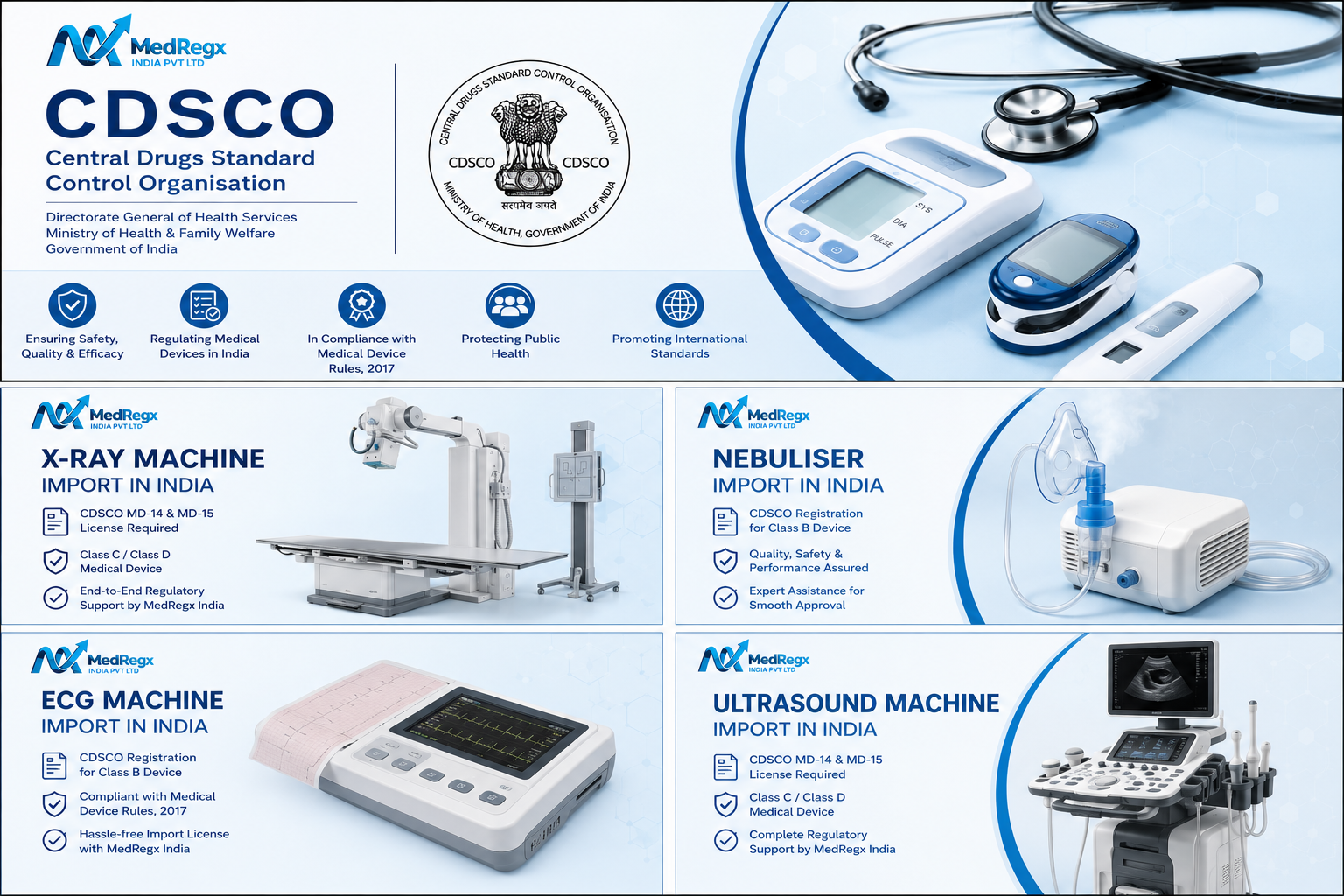
Foreign manufacturers intending to import Class C devices into India must obtain the necessary CDSCO import authorization through the MD-14 application and MD-15 license process.
Additional Documentation
CDSCO may require Device Master Files (DMF), Plant Master Files (PMF), clinical evaluation reports, risk management documentation, and quality system certifications.
Class D Medical Device Registration and Import License
Class D devices are considered the highest-risk category and undergo the most extensive review process.
Examples of Class D Medical Devices
Pacemakers, cardiac stents, heart valves, MRI systems, CT scanners, and implantable defibrillators are examples of Class D devices.
CDSCO Requirements
Applicants must provide comprehensive technical documentation, clinical evidence, safety assessments, quality certifications, and risk evaluation reports.
Due to their critical role in patient care, these devices receive extensive scrutiny before approval is granted.
Who Needs Medical Device Registration?
Medical device registration may be required for Indian manufacturers, foreign manufacturers, importers, Authorized Indian Representatives (AIR), and Indian subsidiaries of overseas medical device companies.
Any entity involved in manufacturing, importing, or marketing regulated medical devices in India must ensure compliance with applicable CDSCO regulations.
Documents Required for Medical Device Registration
Regulatory Documents
Application forms, authorization letters, power of attorney documents, free sale certificates, and declarations may be required depending on the device category.
Quality Documents
ISO 13485 certification, quality management system documentation, and audit reports are commonly required.
Technical Documents
Technical files may include Device Master Files, Plant Master Files, risk analysis reports, device specifications, clinical evaluations, and performance data.
Legal Documents
Company incorporation certificates, GST registrations, authorized signatory details, and business registration documents are often necessary.
Product Information
Labels, packaging artwork, instructions for use (IFU), and marketing materials must comply with Indian regulatory requirements.
Step-by-Step Medical Device Registration Process
Step 1: Device Classification
Determine the correct classification of the medical device under Class A, B, C, or D.
Step 2: Regulatory Assessment
Identify the applicable regulatory pathway and licensing requirements.
Step 3: Documentation Preparation
Compile all required technical, legal, and quality documents.
Step 4: CDSCO Portal Registration
Create and verify an account on the CDSCO online portal.
Step 5: Application Submission
Submit the application along with supporting documentation.
Step 6: Fee Payment
Pay applicable government fees through the designated portal.
Step 7: Technical Review
CDSCO evaluates the application and supporting documentation.
Step 8: Query Resolution
Applicants must respond to any deficiencies or clarification requests raised by CDSCO.
Step 9: Approval Grant
Upon successful review, CDSCO grants the appropriate registration or import license.
Medical Device Registration Timeline
The approval timeline depends on device classification, quality of documentation, and the complexity of the product.
Documentation preparation typically takes two to six weeks, while CDSCO review may take between two and six months. Additional time may be required for query resolution.
Most registrations and licenses are completed within three to nine months when applications are properly prepared.
Benefits of Medical Device Registration
Legal Compliance
Ensures compliance with Medical Devices Rules, 2017 and CDSCO regulations.
Market Access
Allows lawful sale and distribution of medical devices across India.
Enhanced Credibility
Builds trust among hospitals, distributors, healthcare professionals, and procurement agencies.
Business Expansion
Supports growth opportunities in India's rapidly expanding healthcare sector.
Risk Reduction
Helps avoid penalties, customs delays, seizures, and regulatory enforcement actions.
How MedregX India Helps You
Obtaining CDSCO approval requires extensive regulatory expertise and accurate documentation. Even minor errors can result in delays and repeated queries.
MedregX India provides complete end-to-end support for medical device registration, import licensing, and regulatory compliance.
Our Services Include
Device classification assessment, documentation preparation, Device Master File preparation, Plant Master File preparation, CDSCO application filing, Authorized Indian Representative services, query management, approval tracking, and post-approval compliance support.
Why Choose MedregX India?
MedregX India offers experienced CDSCO consultants, specialized medical device regulatory experts, end-to-end project management, transparent communication, and dedicated compliance support.
Our team helps manufacturers and importers achieve faster approvals while maintaining full regulatory compliance with Indian regulations.
Frequently Asked Questions (FAQs)
Is medical device registration mandatory in India?
Yes. Regulated medical devices require registration or licensing before being marketed in India.
Who regulates medical devices in India?
Medical devices are regulated by the Central Drugs Standard Control Organisation (CDSCO).
How are medical devices classified?
Medical devices are classified into Class A, B, C, and D based on risk level.
What is an MD-15 License?
MD-15 is the import license issued by CDSCO for eligible Class C and Class D medical devices.
What is an MD-14 application?
MD-14 is the application form used to apply for an MD-15 import license.
Is an Authorized Indian Representative mandatory?
Yes. Foreign manufacturers must appoint an Authorized Indian Representative for regulatory communication with CDSCO.
Is ISO 13485 certification required?
Yes. ISO 13485 certification is generally required as part of the registration process.
Can I import medical devices without CDSCO approval?
No. Importing regulated medical devices without approval may result in penalties and product detention.
How long does CDSCO approval take?
Approval timelines generally range from three to nine months depending on the product category and documentation quality.
Are CE-marked devices automatically approved in India?
No. CE certification does not replace CDSCO approval requirements.
Contact MedregX India
MedregX India
Phone: +91 7217805020
Email: support@medregx.com
Website: www.medregx.com
Your Key to Regulatory Compliance