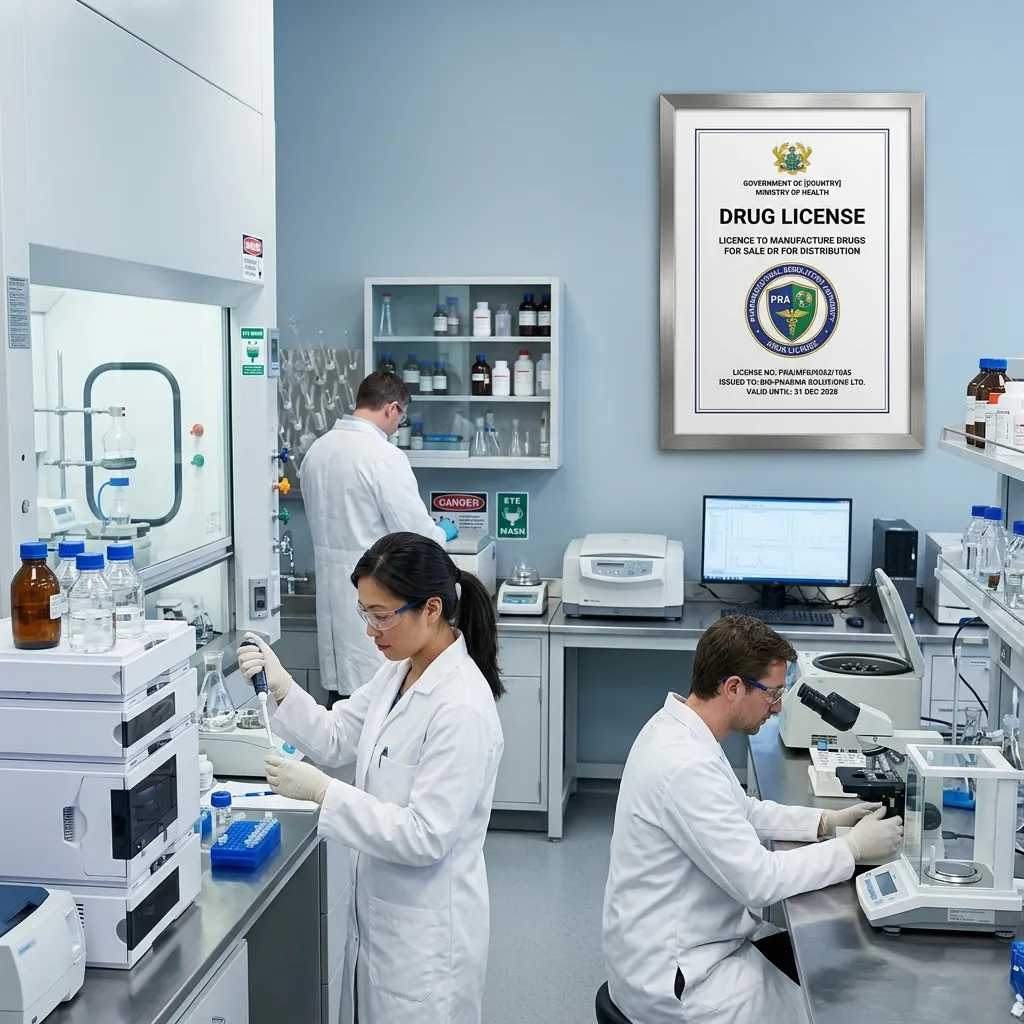
Drug License in India
Complete drug license services for pharmaceutical manufacturers, wholesalers, retailers, and importers under the Drugs & Cosmetics Act 1940.
Service Overview
A Drug License is a mandatory authorization issued under the Drugs & Cosmetics Act 1940 and the Drugs & Cosmetics Rules 1945 for businesses involved in the manufacture, sale, distribution, or import of drugs in India. The license type depends on the nature of business activity.
Drug licenses in India are regulated at two levels: the Central Drugs Standard Control Organisation (CDSCO) regulates new drug approvals and import licenses, while State Drug Controllers (SDCs) handle manufacturing, wholesale, and retail licenses.
MedRegX India provides end-to-end drug license services — from eligibility assessment and documentation preparation to site inspection support, license application filing, query resolution, and license renewal management.
Key Takeaways
- A drug licence under the Drugs & Cosmetics Act, 1940 is mandatory for anyone manufacturing, selling, distributing or importing drugs in India.
- Licences split across two levels: State Drug Controllers issue manufacturing, wholesale and retail licences; CDSCO handles new-drug approvals and import licences.
- The licence type follows the activity — Form 25/28 (manufacturing), Form 20B/21B (wholesale), Form 20/21 (retail).
- A qualified pharmacist or competent technical person and compliant premises are non-negotiable prerequisites for grant.
- Manufacturing licences require Schedule M GMP compliance, verified through a physical inspection of the site.
Which Drug Licence Do You Actually Need?
The first question is never how to apply — it is which licence your business activity requires, because the wrong application wastes weeks and a rejection resets the clock. A retail pharmacy selling to consumers needs a retail licence (Form 20/21). A distributor or stockist selling to other businesses needs a wholesale licence (Form 20B/21B). A company physically making formulations needs a manufacturing licence (Form 25 for non-biologicals, Form 28 for biologicals). And a business importing finished drugs needs a central import licence through CDSCO, not a state licence at all.
Many businesses need more than one. A manufacturer that also distributes its own products, or a chain that both stocks and retails, will hold multiple licences at once. We map every activity in your business model to the licence it triggers at the outset, so nothing surfaces later as an unlicensed operation that customs, an inspector, or a tender authority can flag.
- Retail sale to consumers — Form 20/21 (retail drug licence), requires a registered pharmacist.
- Wholesale / distribution — Form 20B/21B, requires a competent person with prescribed qualifications.
- Manufacturing — Form 25 (non-biological) or Form 28 (biological), requires Schedule M compliance.
- Import of finished drugs — central CDSCO import licence, not a state licence.
Premises, People and Schedule M: What Inspectors Check
A drug licence is granted against a specific premises and a specific qualified person, and both are inspected before approval. For retail and wholesale licences, the State Drug Controller's inspector verifies the physical area (minimum floor space is prescribed), storage and refrigeration for temperature-sensitive drugs, and the presence and qualification of the pharmacist or competent person named on the application. Gaps here — an under-sized premises, a missing cold-chain unit, or a pharmacist whose registration is not current — are the most common reasons a licence is held up.
Manufacturing licences add a further layer: Schedule M Good Manufacturing Practices. The inspection reviews facility design, cleanroom classification, HVAC and air-change rates, water systems, and documented quality procedures. We prepare the site, documentation and SOPs to Schedule M before the inspection, and provide mock-audit support, so the licensing visit is a confirmation rather than a discovery of gaps. This front-loaded approach is what keeps a manufacturing licence moving through the 60-to-90-day window rather than looping through repeated re-inspections.
Required Documentation
"Accurate documentation is 70% of the battle. Our experts pre-audit every file before submission."
Our Delivery Workflow
License Type Assessment
Determine the applicable drug license type based on your business activity, products, and state requirements.
Infrastructure Review
Review premises, equipment, and personnel to ensure they meet Schedule M / state regulatory requirements.
Document Preparation
Prepare all application documents, layout drawings, SOPs, and declarations required by the State Drug Controller.
Inspection & Approval
Coordinate site inspection, address inspector queries, and obtain the drug license certificate.
Frequently Asked Questions
Have questions? Find direct, humanized answers about the regulatory approvals and timelines.

Launch Your Product In Record Time
Red tape shouldn't decide your launch date. We keep the paperwork moving and the queries answered, so approvals come through sooner.