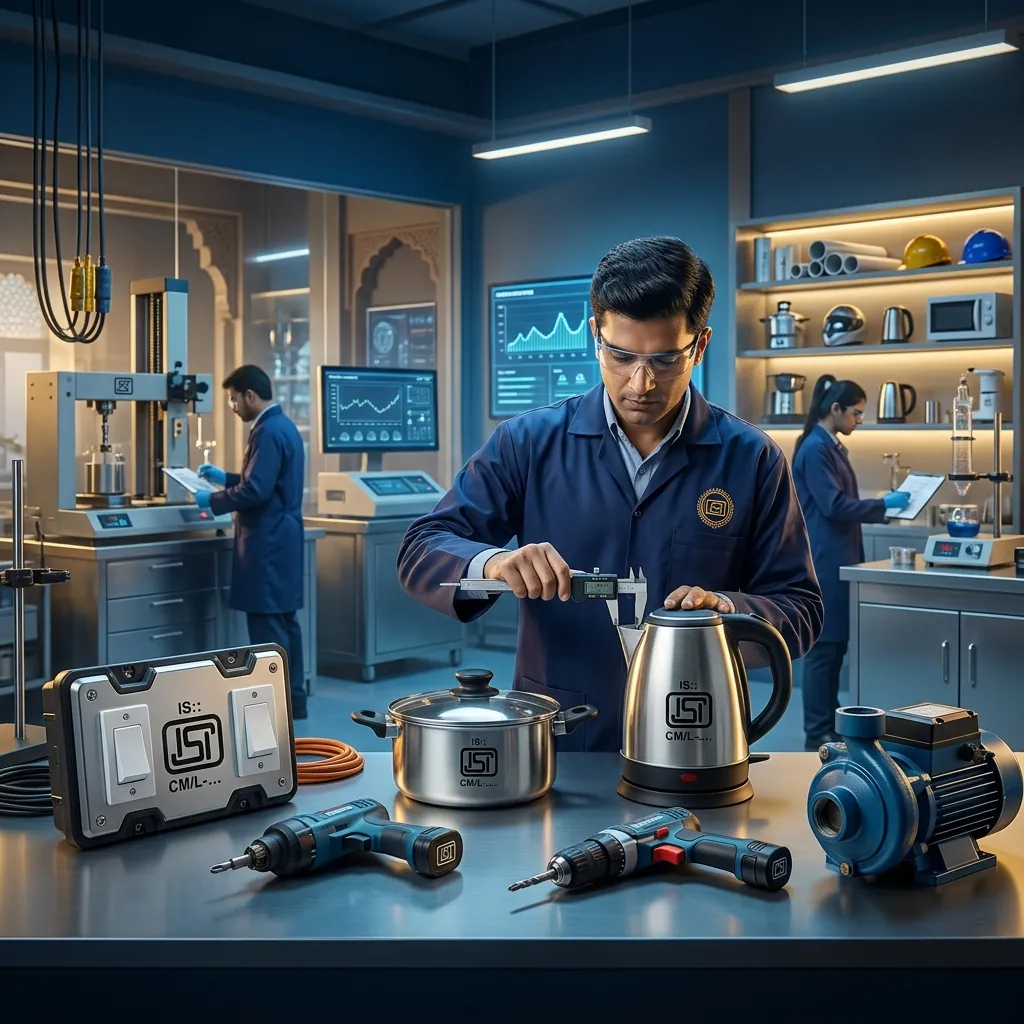
BIS ISI Certification for Domestic Manufacturers
Earn the ISI mark for products made in India — BIS product certification under Scheme I, from application and testing to the factory inspection and licence, so your product carries the mark customers and regulators trust.
Service Overview
The ISI mark is one of the most recognised quality marks in India, and for a domestic manufacturer it is often the difference between a product that sells freely and one that cannot. Administered by the Bureau of Indian Standards, ISI certification confirms that a product conforms to the relevant Indian Standard, and for a long and growing list of products it is not merely a marketing advantage but a legal requirement — those products cannot be sold without it. Whether it is mandatory for you or a competitive edge, the ISI mark is a serious asset worth getting right.
For an Indian manufacturer, ISI certification is granted under what is now Scheme I of the BIS conformity assessment framework. The essence is straightforward: you demonstrate that your product meets the applicable Indian Standard and that your factory can consistently make it that way. That "consistently" is important — BIS is not just testing a sample, it is licensing you to keep making conforming product, which is why the process combines product testing with an inspection of your manufacturing and quality control.
The first real task is often identifying the correct Indian Standard and confirming a product is covered. India has thousands of standards, and mapping your specific product to the right one — and establishing whether ISI certification is mandatory for it — is where the process begins. Getting this wrong sends the whole application down the wrong track, so it is worth the care, particularly for products where the applicable standard is not obvious.
Testing sits at the heart of the application. Samples of your product are tested against the requirements of the Indian Standard, usually in a BIS-recognised laboratory, and the results have to demonstrate conformity across the parameters the standard specifies. A test failure means addressing the underlying product or process issue before proceeding, so understanding what the standard demands — and making sure your product genuinely meets it — before formal testing saves costly repetition.
Alongside testing comes the factory inspection. A BIS officer visits your manufacturing premises to verify that you have the machinery, the process control and the in-house testing capability to produce conforming product consistently, and that your quality management is real. This inspection is where many first-time applicants stumble, because it assesses not just the product but the system that makes it — and a factory that is not ready for that scrutiny collects observations that delay the licence.
We guide domestic manufacturers through the whole ISI journey — identifying the right standard, preparing for and coordinating testing, readying the factory and quality system for inspection, and managing the BIS application through to the grant of your licence — so your product earns the ISI mark cleanly and keeps it through the surveillance that follows.
Key Takeaways
- The ISI mark is India’s oldest product certification — mandatory for a defined list of products under Scheme I of the BIS Conformity Assessment Regulations.
- It is granted per product per factory after sample testing and a factory inspection.
- Domestic makers apply under the standard scheme; overseas makers use FMCS for the same ISI mark.
What the ISI Mark Means and Why It Matters
The ISI mark on a product tells a buyer, a retailer and a regulator that the product conforms to the relevant Indian Standard and is made under a BIS licence. That trust is commercially valuable in its own right, but for many products the mark is more than trust — it is a legal gate. The government has progressively brought products under mandatory ISI certification, meaning they cannot legally be manufactured, imported, stored or sold without it, with real penalties for non-compliance. For those products, the ISI mark is simply the price of being in business.
Knowing whether your product falls under mandatory certification, and which standard applies, is therefore the first question we answer. For a mandatory product, ISI is not optional and the timeline to obtain it directly affects when you can sell; for a voluntary one, it is a competitive decision. Either way, we make sure you understand exactly where your product stands so the effort of certification is aimed at a clear commercial purpose rather than pursued blindly.
- The ISI mark confirms conformity to an Indian Standard under a BIS licence.
- For many products it is legally mandatory to sell.
- The first step is knowing whether your product is covered and by which standard.
Finding the Right Indian Standard
India has thousands of standards covering everything from cement and steel to electrical goods and household products, and the whole certification hinges on matching your product to the correct one. For some products the applicable standard is obvious; for others, particularly newer or hybrid products, identifying the right standard — and confirming the product is within the scope of ISI certification at all — takes genuine familiarity with the BIS system. An application filed against the wrong standard is an application built on sand.
We identify the applicable Indian Standard for your specific product and confirm its certification status, so the application starts on firm ground. This also clarifies exactly what the product will be tested against, which lets us assess up front whether it genuinely conforms — because there is no point beginning a formal application if the product cannot meet the standard as it stands. Getting this foundational mapping right is quiet work that prevents loud problems later.
Product Testing Against the Standard
ISI certification requires that your product be tested against the requirements of the applicable Indian Standard, typically in a BIS-recognised laboratory. The standard specifies the characteristics the product must meet — dimensions, materials, performance, safety parameters — and the testing has to demonstrate conformity across them. This is the objective heart of the certification: whatever else is true, the product either meets the standard or it does not, and the test results are the evidence.
We coordinate the testing, help you understand precisely what the standard demands, and where sensible arrange preliminary checks so that a product’s conformity is understood before formal testing rather than discovered to be lacking during it. A failed test is not fatal, but it means fixing the underlying issue and retesting, which costs time and money. Approaching testing with a clear grasp of the standard’s requirements is how we keep that from becoming a repeated, expensive cycle.
The Factory Inspection
BIS does not just test a sample; it licenses you to keep making conforming product, so it inspects the factory that will make it. A BIS officer visits your premises to verify that you have the necessary manufacturing machinery, that your process is controlled, that you have the in-house testing facilities the standard requires to check your own production, and that your quality management is genuine. The inspection assesses your capability to produce to the standard consistently, not just once.
This is where many first-time applicants are caught out, because they have focused on the product and neglected the system around it. We prepare your factory and quality control for the inspection: making sure the required machinery and in-house testing capability are in place, the process controls are documented and followed, and the quality records the officer will look for actually exist. A factory readied properly passes with minor observations; one that treats the inspection as an afterthought collects findings that hold up the licence.
- A BIS officer inspects the factory, not just the product.
- Machinery, process control and in-house testing are assessed.
- An unprepared factory collects observations that delay the licence.
From Application to Licence
The ISI process pulls these threads together into a BIS application: the identified standard, the test results, the factory details and the quality documentation, submitted and pursued through BIS to the grant of a licence to use the Standard Mark. Managing this application — responding to BIS queries, coordinating the sequence of testing and inspection, and keeping the file moving — is a real piece of work, and delays often come from the application drifting rather than from any fundamental problem with the product.
We handle the application and the liaison with BIS end to end, so the process advances steadily rather than stalling in correspondence. Because we have prepared the product, the testing and the factory in advance, the application tends to encounter fewer obstacles, and where BIS does raise a point we address it promptly. The outcome is the licence that lets you legally apply the ISI mark — the tangible goal the whole exercise is aimed at.
Keeping the Licence: Surveillance and Renewal
An ISI licence is not permanent and unconditional; BIS maintains oversight through surveillance — periodic verification, including market samples and factory checks, that you continue to produce conforming product — and the licence has to be renewed. A manufacturer who obtains the mark and then lets quality slip risks surveillance failures that can suspend or cancel the licence, which for a mandatory product means losing the ability to sell. The mark is a continuing commitment, not a one-time achievement.
We help you sustain the quality discipline and the records that keep surveillance uneventful, and we manage renewals so the licence stays valid. For a manufacturer whose market access depends on the ISI mark, this ongoing support is as important as obtaining the licence in the first place — a lapsed or cancelled licence is an avoidable and serious blow. We treat the ISI mark as the durable asset it is, worth protecting for as long as you make the product.
ISI vs CRS vs FMCS at a Glance
| Scheme | Mark | Who Uses It |
|---|---|---|
| ISI (Scheme I) | ISI mark | Indian manufacturers |
| CRS (Scheme II) | Self-declaration + R-number | Electronics / IT makers |
| FMCS | ISI mark | Foreign manufacturers |
Required Documentation
"Accurate documentation is 70% of the battle. Our experts pre-audit every file before submission."
Our Delivery Workflow
Standard & Scope
We identify the applicable Indian Standard and confirm your product’s certification status.
Testing
We coordinate testing against the standard in a BIS-recognised laboratory.
Factory Readiness
We ready your machinery, in-house testing and quality control for the BIS inspection.
Application to Licence
We manage the BIS application and liaison through to the grant of your ISI licence.
Frequently Asked Questions
Have questions? Find direct, humanized answers about the regulatory approvals and timelines.

Launch Your Product In Record Time
Red tape shouldn't decide your launch date. We keep the paperwork moving and the queries answered, so approvals come through sooner.