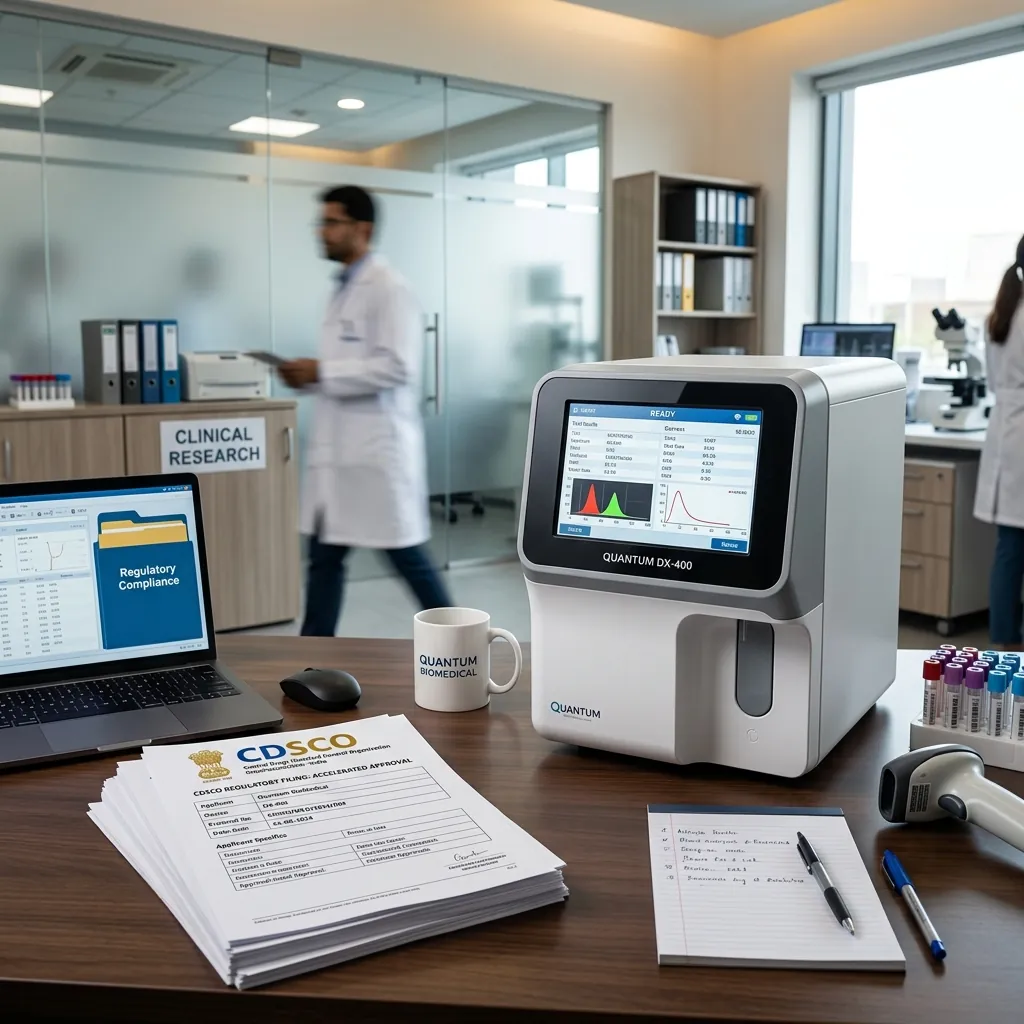
CDSCO Manufacturing License for Medical Devices
Set up legal medical-device manufacturing in India — the right form for your class (MD-5 or MD-9), a plant that passes audit the first time, and full liaison with the licensing authority.
Service Overview
If you want to manufacture a medical device in India, you need a manufacturing licence from CDSCO before you can make a single unit for sale. Which licence, and which authority grants it, depends entirely on your device class — and that is the first fork in the road that decides how long the whole thing takes.
Class A and B devices are handled by the State Licensing Authority. You apply on Form MD-3 and, once cleared, hold your licence on Form MD-5, usually after a self-declaration that your quality system meets ISO 13485:2016. Class C and D devices go to the central authority. You apply on Form MD-7 and the licence (Form MD-9) is granted only after inspectors physically audit your plant. That audit is where most applications live or die.
A manufacturing application is really an assessment of your facility, not just your paperwork. Reviewers and inspectors want to see cleanrooms of the right grade, environmental monitoring that actually runs, validated sterilisation, controlled water systems, and finished-product release testing that holds up. Promising these in a document is not enough — they have to exist and be evidenced when the inspector walks in.
This is why we get involved before the plant is finished, not after. We help design the facility layout and the ISO 13485 quality management system around what the audit will ask for, prepare the Plant Master File and Device Master File, and run a full mock inspection so nothing is a surprise on the day. If you also plan to import while you build local capacity, the manufacturing route runs alongside the CDSCO import registration (Form MD-15) route.
Once the file is ready we submit on the SUGAM portal, coordinate the audit, and answer every observation until the licence is granted. A well-prepared plant clears its audit with minor observations at most; an unprepared one collects a list of critical findings that can set the launch back by months.
Key Takeaways
- A manufacturing licence is site-specific — it is tied to the exact premises and the devices you make there.
- Class A/B licences (MD-5) come from the State Licensing Authority; Class C/D licences (MD-9) come from central CDSCO.
- Class A is largely a self-certification audit; Class C and D require a joint physical inspection of the plant.
- A working ISO 13485 quality system and a compliant cleanroom are effectively pre-conditions, not paperwork afterthoughts.
MD-5 vs MD-9: Which Licence You Actually Need
The single biggest determinant of effort is your device class. Class A and B manufacturers apply to the State Licensing Authority on Form MD-3 and receive an MD-5 licence, and for these classes the state often accepts a self-declaration of ISO 13485 conformity rather than a full physical audit. That makes the route faster and lighter, though the quality system still has to be real.
Class C and D manufacturers apply centrally on Form MD-7 and receive an MD-9 licence only after a joint audit by CDSCO drug inspectors and notified-body experts. This is a serious, on-site technical inspection. If your device family spans classes, you may need more than one licence, and getting that mapping right at the start avoids duplicated fees and effort.
- Class A & B: Form MD-3 → Form MD-5, State Licensing Authority, often self-declaration.
- Class C & D: Form MD-7 → Form MD-9, Central Authority, mandatory joint audit.
- Loan licences are available if you manufacture at someone else’s approved site.
The Audit Is the Real Test
For Class C and D, the plant audit is the moment everything is judged. Inspectors look at cleanroom classification and the data behind it, environmental and personnel monitoring, gowning discipline, water-system validation, sterilisation and its validation records, calibration, and how you test and release finished product. They also check that your written procedures match what people actually do on the floor — a mismatch there is one of the most common reasons for adverse observations.
We prepare your team for this the way a good coach prepares for a match: a documented quality system, trained operators, and a full mock audit that surfaces the weak points while there is still time to fix them. Walking into a CDSCO inspection cold is the single most expensive mistake a new manufacturer can make.
Documents Behind a Manufacturing Licence
The Plant Master File is the spine of the application. It documents the site — layout, HVAC and air-change design, water systems, environmental controls, equipment, and the qualifications of the people running it. Alongside it sits the Device Master File for each product you intend to make, plus your ISO 13485:2016 certification, product specifications, validation protocols and labelling. For Class C and D, add the technical evidence a central review expects: risk files, sterilisation validation and stability data.
The theme, as with every CDSCO submission, is internal consistency. The layout in your Plant Master File has to match the plant the inspector sees; the specifications in your Device Master File have to match your test records. We build these files together so they tell one coherent story.
Timelines and What Delays a Manufacturing Licence
Class A and B licences from the State Licensing Authority are typically issued in about 45 to 60 days once the file and quality system are in order. Class C and D licences run 90 to 120 days, with the audit and its follow-up being the main variables. The delays that hurt most are avoidable ones: a plant that is not audit-ready, procedures that do not match practice, or slow responses to inspector observations. Preparation up front is what keeps the timeline honest.
- Class A & B: roughly 45–60 days via the State Licensing Authority.
- Class C & D: 90–120 days, driven by the audit and observation close-out.
- A mock audit before inspection is the best single predictor of a clean result.
- Testing samples before full production? Use a test licence first.
Loan Licences, Contract Manufacturing and Site Changes
Not every company that wants to sell a device under its own name needs to build a factory. A loan licence lets you manufacture your product at another company’s already-approved facility, using their equipment and quality system while you hold your own product licence. For a start-up or a company testing a new line, this can be the difference between launching this year and launching in three years — you carry the regulatory and brand responsibility without the capital cost of a plant.
Contract manufacturing works on a similar principle but with the roles reversed, and both arrangements need their paperwork drawn up carefully so it is clear to CDSCO who is responsible for what. We structure these agreements so the licence, the site and the product owner all line up, because a loose arrangement here is exactly what an inspector will pull on.
Once you are licensed, the licence has to keep pace with the plant. Adding a product line, changing a cleanroom, moving equipment, or altering a validated process are not things you can simply do and document later — several of them require prior endorsement from the authority. We manage these post-licence variations so your manufacturing licence always reflects the plant that actually exists, which is precisely what the next audit will check.
Building a Plant That Passes the First Time
The cheapest audit is the one you only have to do once. A plant that goes into inspection with a quality system that is genuinely running, operators who know their procedures, and documentation that matches the floor tends to come out with a short list of minor observations. A plant that treats the audit as a paperwork exercise comes out with critical findings, a re-inspection, and a launch date that has quietly slipped a quarter.
That is why we get involved while the facility is still being fitted out, not after it is built. Retrofitting a cleanroom classification or a water-system validation into a finished plant is far more expensive than designing for it from the start. We work with your engineering team so the layout, the airflow, the gowning flow and the monitoring are all built around what the inspector will actually ask to see, and then we rehearse the whole thing in a mock audit before the real one.
What the Licensing Fee Actually Buys You
The government fee for a manufacturing licence is modest next to the cost of the facility itself, and it scales with your device class and the number of devices on the application. But the fee is the smallest part of the real budget. The genuine investment is the plant: the cleanrooms, the HVAC, the water system, the validated equipment, the trained people and the quality system that ties them together. This is where a company either sets itself up to pass audits for years or builds in problems it will pay for repeatedly.
We help you spend that budget where it counts. Over-engineering a facility wastes capital; under-engineering it fails the audit and costs far more to fix once the walls are up. By designing the plant around the exact class and processes you need — no more, no less — we keep the build proportionate and the licence achievable, so your capital goes into capability rather than into rework after a failed inspection.
Manufacturing Licence by Class
| Class | Application | Licence | Inspection |
|---|---|---|---|
| A | MD-3 | MD-5 (State) | Self-certified audit |
| B | MD-3 | MD-5 (State) | Risk-based audit |
| C | MD-7 | MD-9 (Central) | Joint physical inspection |
| D | MD-7 | MD-9 (Central) | Joint physical inspection |
Our Delivery Workflow
Route & Gap Assessment
We confirm your class, map the correct form pathway, and audit your plant and quality system against CDSCO expectations.
Build & Document
We help align facility, cleanrooms and the ISO 13485 system, then prepare the Plant and Device Master Files.
File & Mock Audit
We submit on SUGAM and run a full mock inspection so the real audit holds no surprises.
Audit to Grant
We support the on-site CDSCO audit, close out observations, and see the file through to your licence.
Frequently Asked Questions
Have questions? Find direct, humanized answers about the regulatory approvals and timelines.

Launch Your Product In Record Time
Red tape shouldn't decide your launch date. We keep the paperwork moving and the queries answered, so approvals come through sooner.